

As developers grow, sooner or later a question comes up:
What comes after Senior Software Engineer?
One possible answer is becoming a Technical Lead or Tech Lead. The name can be misleading: it is easy to assume this person is the boss who assigns tasks, evaluates people, and tracks productivity.
A Tech Lead is still, first and foremost, a software engineer. The difference is that their responsibility no longer ends when their code works: they also need to make sure the system the team is building makes technical sense.
What is a Technical Lead?
A simple definition would be:
A Tech Lead is a senior engineer responsible for guiding the technical direction of a project or team.
They help the team answer questions like:
- How should we build this solution?
- Which technology should we use, and why?
- Which risks are we willing to accept?
- How do we keep the system observable and able to grow?
They do not have to answer them alone: good technical leadership involves the team and spreads knowledge. Its responsibility is to make sure technical decisions remain coherent with one another.
A Tech Lead is still an engineer
In some organizations, the new Tech Lead stops coding, fills their calendar with meetings, and loses touch with the system they lead.
They do not have to write more code than everyone else, but they should keep designing solutions and reviewing critical parts: losing touch with the system makes it much harder to lead it technically.
What is a Tech Lead responsible for?
The scope changes by company, but six responsibilities appear regularly.
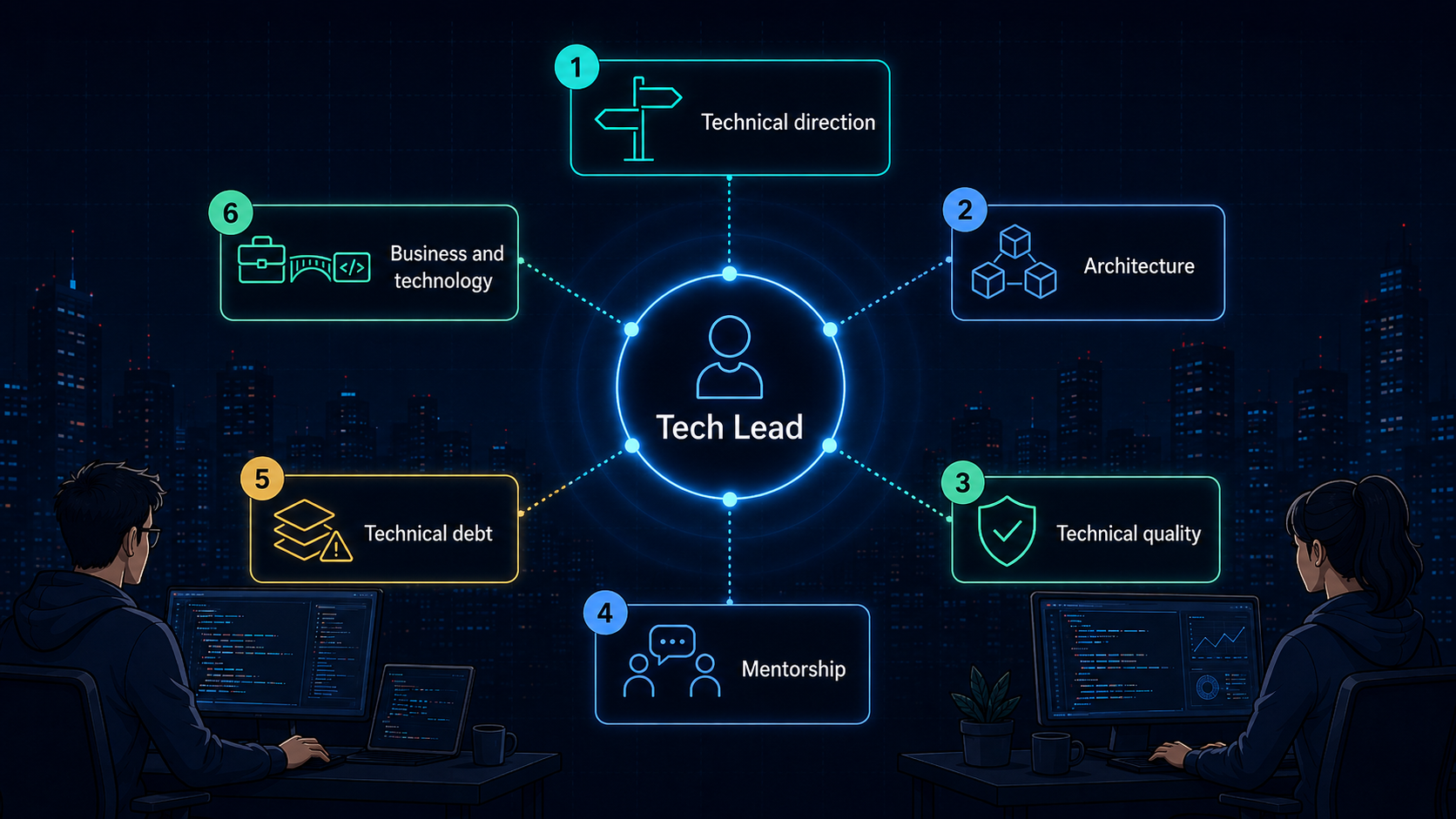
1. Technical direction
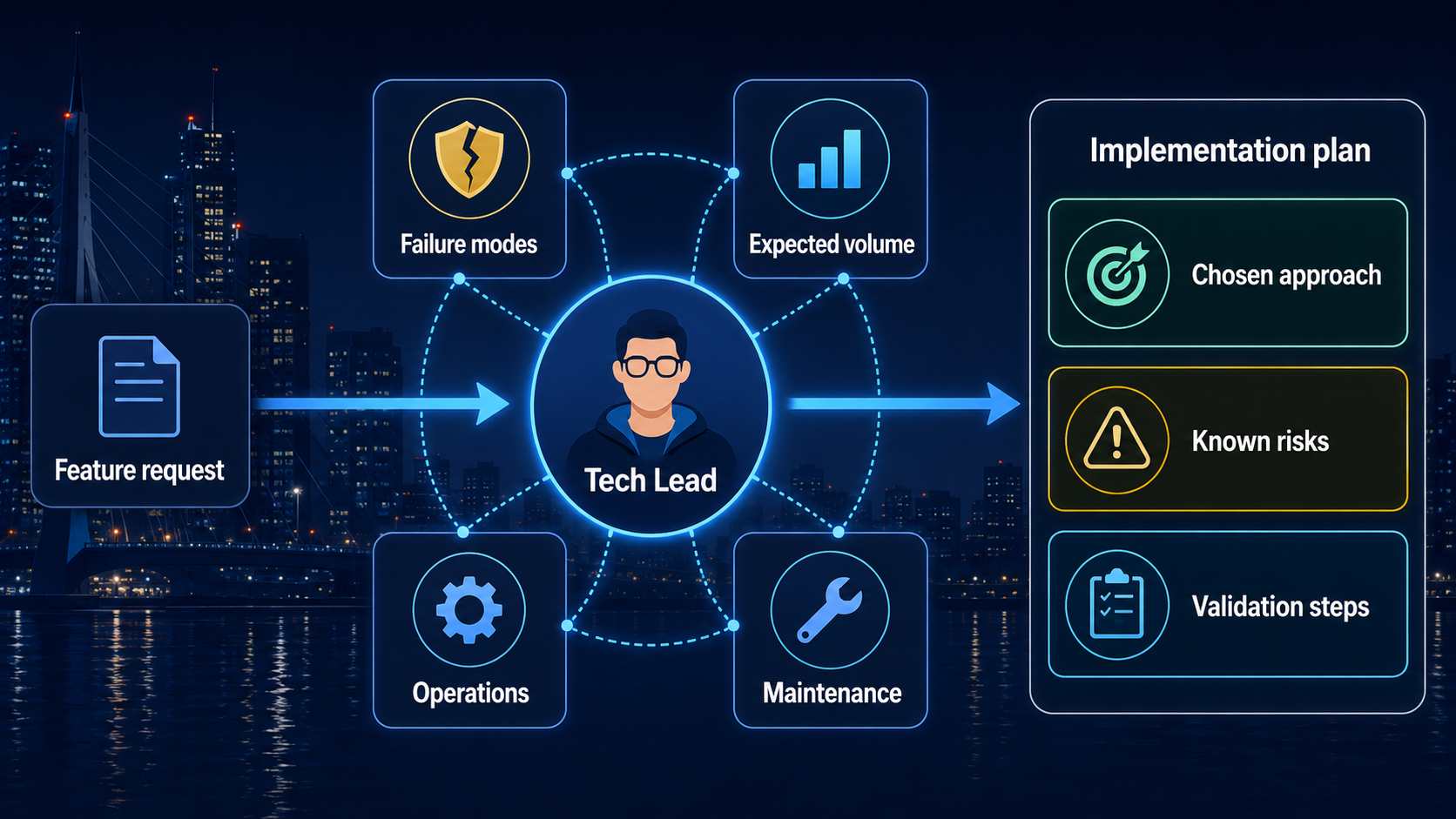
When Product asks to “send a notification when an event occurs,” someone must think beyond the ticket. Should it be synchronous? Do we need a queue? What happens if the provider fails?
The Tech Lead turns a business need into a solution the team can implement and maintain.
2. Architecture
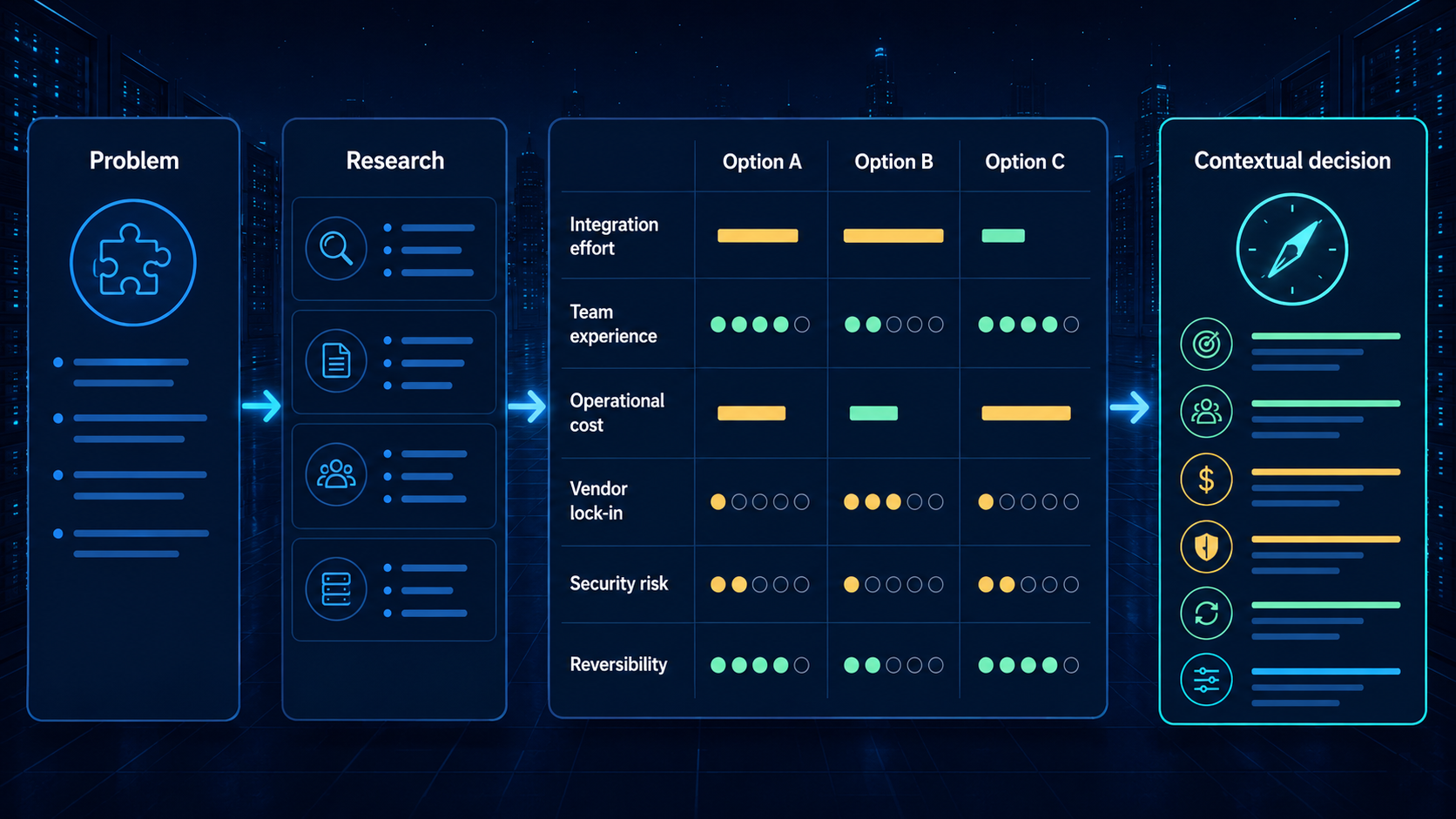
Architecture starts before anyone draws boxes and arrows. First the team needs to understand the problem and compare the alternatives:
- How easy is it to integrate with the current system?
- Does the team have the experience to operate it?
- What cost or vendor dependency does it introduce?
- What security risk does it add?
That research settles the underlying decisions:
- How services communicate.
- Where data is stored.
- Which work should be asynchronous.
- How authentication, observability and deployment are handled.
The diagram documents those decisions; it does not replace them. And the goal is not the most sophisticated solution: part of the job is saying “we do not need this much complexity to solve the problem”.
3. Technical quality
The Tech Lead helps define what it means for a change to be done: which tests it needs, how it handles errors, what documentation and which signals are needed to operate it in production.
Maintaining that standard does not mean approving every Pull Request: if everything requires their authorization, the Tech Lead becomes a bottleneck. The goal is for the team to sustain quality without depending on one person.
4. Technical mentorship
Mentorship is the Tech Lead's multiplier: it raises what each person is capable of so the team becomes more autonomous and resilient. It is not about teaching syntax or tools, but about building judgment, confidence and professional independence.
That is why it happens in everyday work, and almost always as a question. Instead of “do it this way”: “what happens if this service gets ten times more traffic?” or “what if this dependency stops responding?” Pair programming, code reviews and incident analysis do the rest.
It is working when the team needs fewer and fewer direct answers.

5. Technical debt
Choosing the quick solution over the solid one saves time today and costs it later. That pending cost is technical debt: the rework that will have to happen sooner or later.
Sometimes it is worth taking on — shipping sooner, validating an idea — but it always charges interest. And not all of it is chosen: it also builds up when the system stays the same and the needs change.
You notice it when a deployment depends on manual steps only one person knows, or when the same incident returns because its cause was never addressed.
The Tech Lead makes it visible, attaches a concrete risk to it (security, reliability or delivery) and prioritizes it alongside product work, not in a separate backlog. Debt that threatens the business gets paid now; the rest can wait, if that is an explicit decision.
6. Translating business into technology
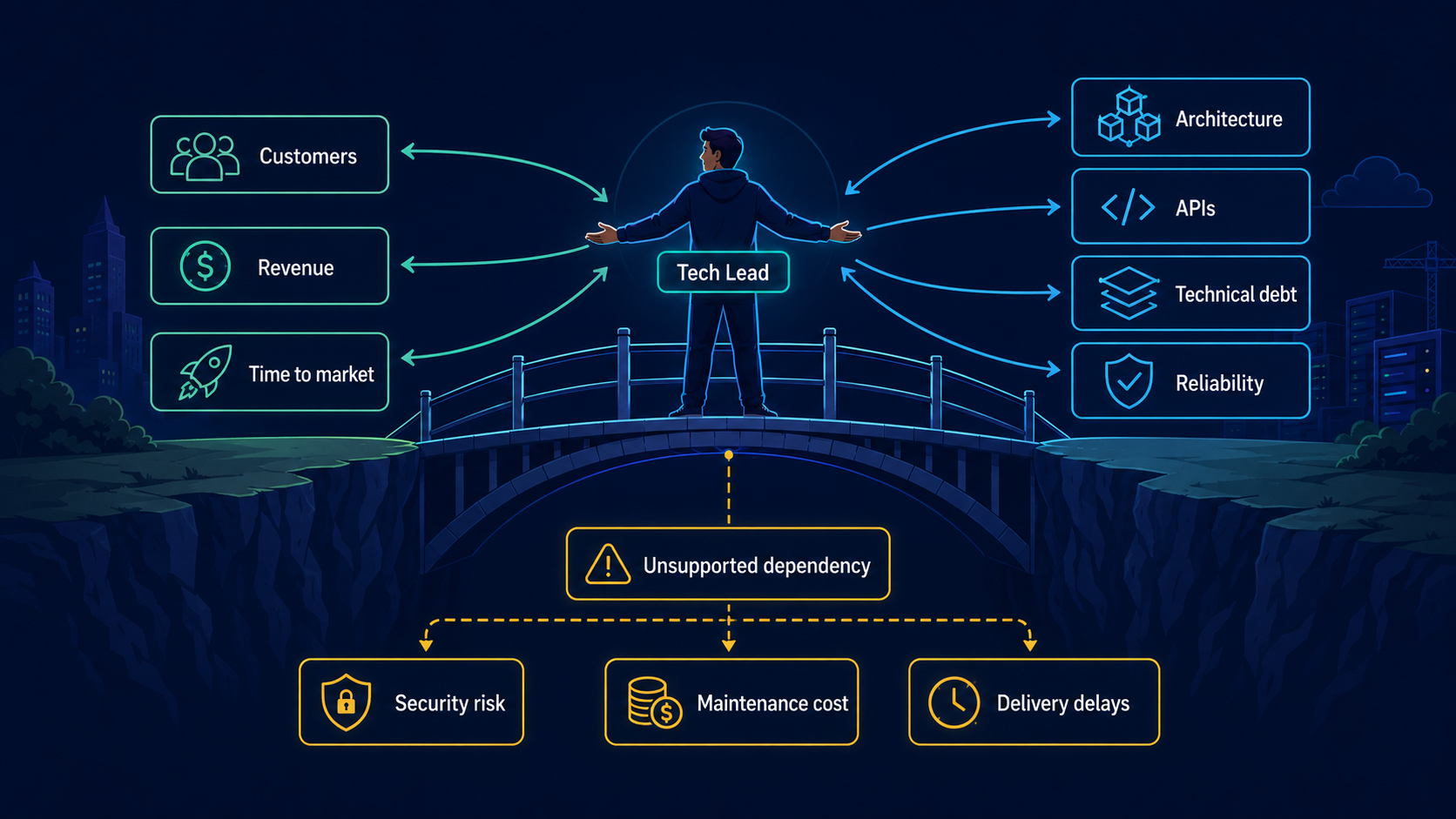
Product talks about customers, revenue and costs. Engineering talks about APIs, latency, availability and technical debt. The Tech Lead connects both worlds.
Instead of “we must migrate because the framework is obsolete,” they can explain, “The framework is no longer supported; that increases our security risk and will make the system increasingly expensive to maintain.” The decision is the same; now it has a business reason.
A Tech Lead is not an Engineering Manager
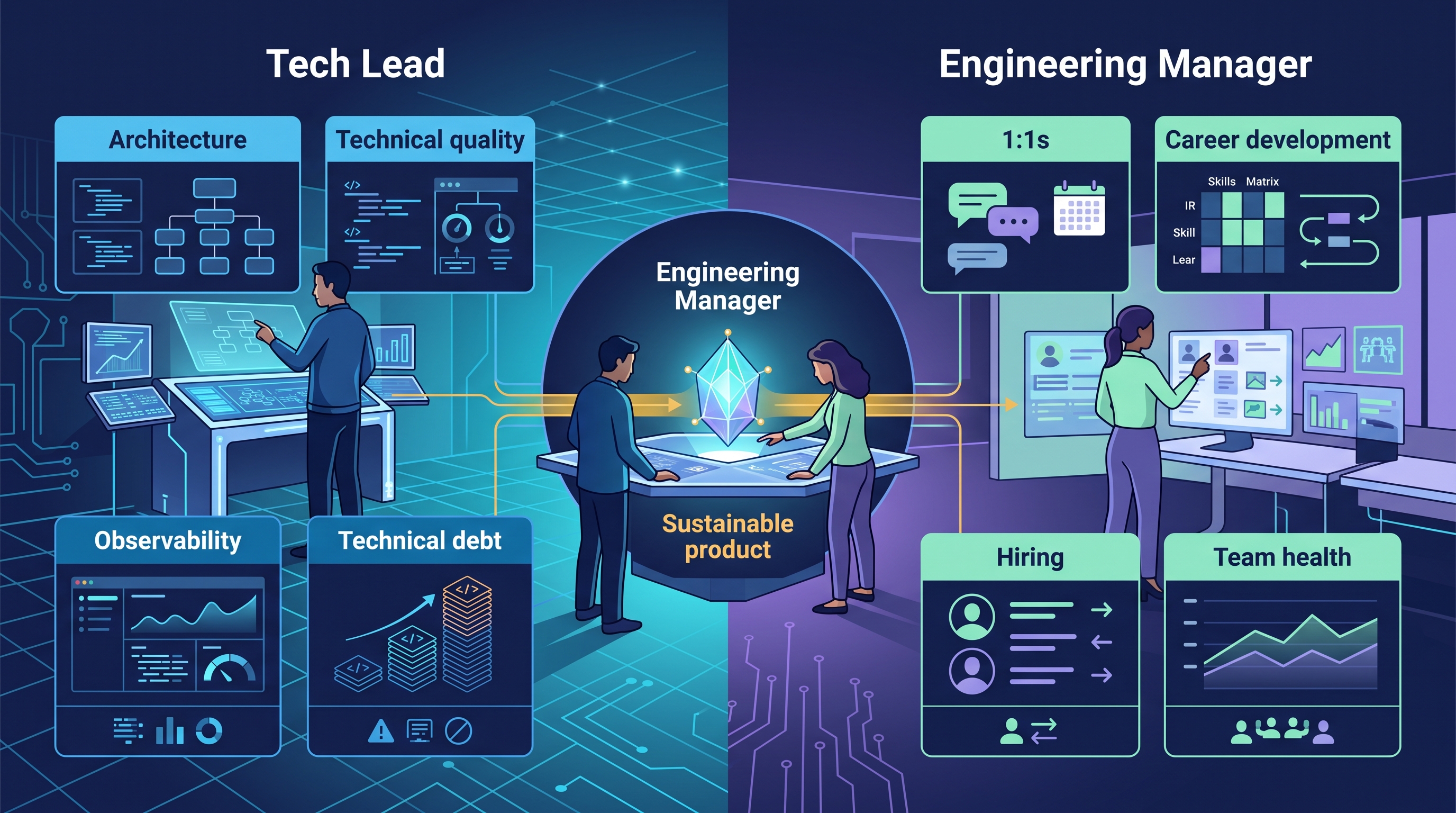
Both are leadership roles, but their primary responsibility differs: the Tech Lead focuses on the system; the Engineering Manager focuses on people and the team.
| Area | Tech Lead | Engineering Manager |
|---|---|---|
| Architecture and quality | Primary owner | Participates and supports |
| Implementation and code review | Frequent | Occasional |
| Technical mentorship | Responsible | May participate |
| 1:1s and career development | May advise | Responsible |
| Performance and promotions | No | Responsible |
| Hiring | Technical assessment | Owns the process |
| Team health | Collaborates | Responsible |
This does not mean one ignores people and the other ignores technology. On small teams one person may cover both roles; what matters is making ownership explicit so neither the system nor the people are neglected.
They are not a Project Manager either
A Tech Lead needs to understand project status and participate in estimates: engineering sees dependencies and risks other roles miss. Their value does not come from chasing tickets.
Their questions should be: Is the solution correct? What must we validate before committing to a date?
What should a Tech Lead focus on?
On a balance. Obsessing over speed pushes the team into shortcuts and debt. There are four areas, each with its own KPIs.
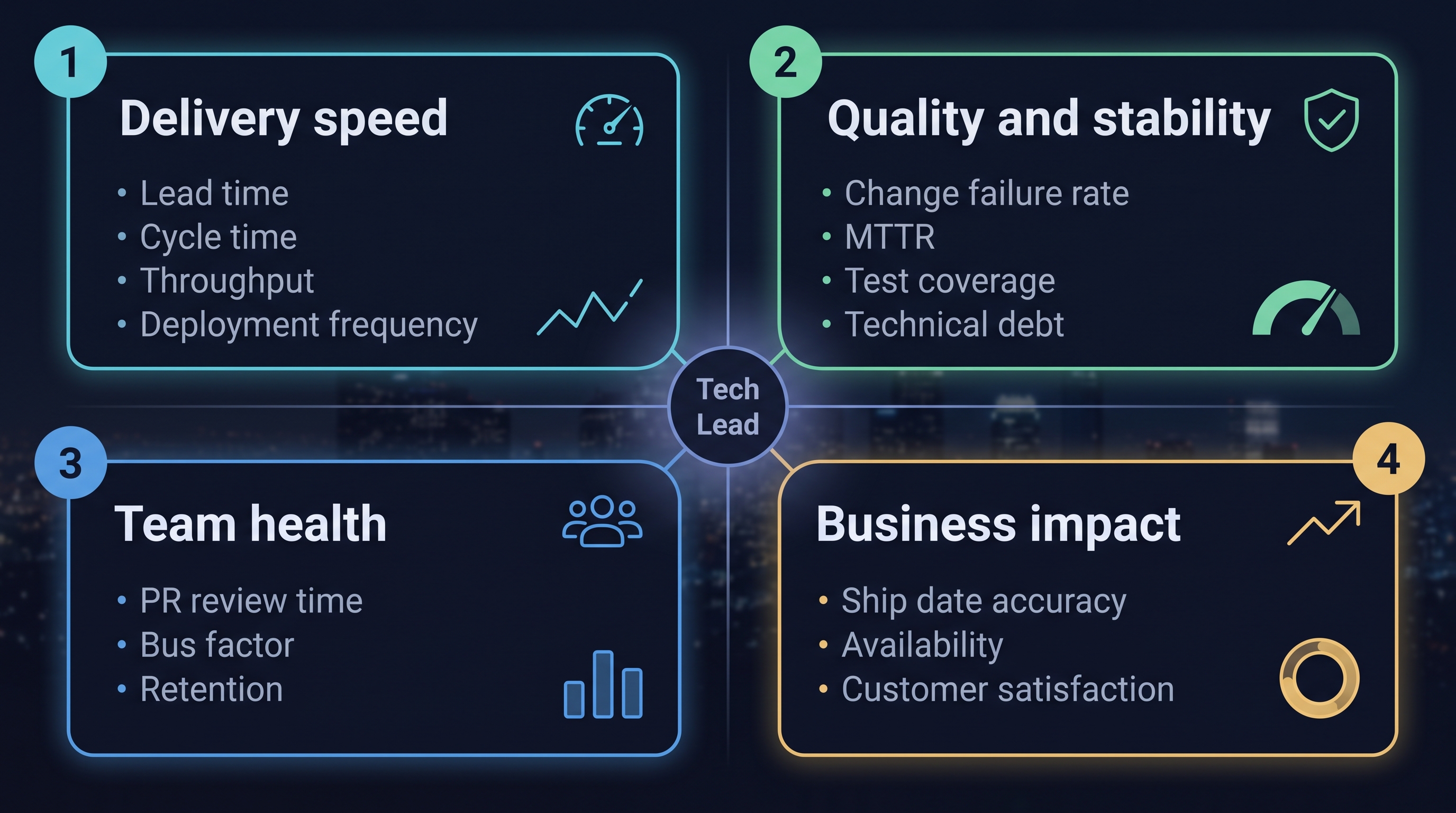
1. Delivery speed
How quickly and predictably work reaches production.
- Lead time — from a task being created to it reaching production.
- Cycle time — from work starting on it to it being done. It exposes bottlenecks.
- Throughput — items completed per sprint. Steadier than story points.
- Deployment frequency — releases to production. High-performing teams, daily or weekly.
2. Quality and stability
Making sure speed is not paid for with the system.
- Change failure rate — share of deployments that cause incidents or need a hotfix.
- MTTR — how long it takes to restore service after a failure.
- Test coverage — a sharp drop is a warning.
- Technical debt — code that needs refactoring. It should stay flat or trend down.
3. Team health
A blocked or burned-out team eventually drags the delivery numbers down with it.
- PR review time — how long a Pull Request takes to be reviewed and merged.
- Bus factor — how many people would have to be away to stall the project. Push it up.
- Retention and satisfaction — team turnover and engagement surveys.
4. Business impact
Whether the technical work is serving the company.
- Ship date accuracy — how closely estimates match actual delivery.
- Availability — system uptime in production.
- Customer satisfaction — NPS or CSAT on what was shipped.
There is no need to measure everything at once: pick one KPI per area, aligned with what the company is aiming for, and read it as a trend.
In summary
A Tech Lead is still an engineer, but their responsibility no longer ends with their own code: they keep the technical direction clear and prevent today's decisions from making tomorrow's product harder to change.
They do not replace the Engineering Manager or the Project Manager, and their work shows not in a single number but in the balance between delivery, quality, team health and business impact.
A good Tech Lead does not make every decision: they help the team understand the context and make sound decisions on its own.
References
- LinkedIn Talent SolutionsTechnical Lead Job Description Template
- SourceLevel5 Responsibilities of a Tech Lead and 17 Metrics to Track Their Performance
- Engineering LaddersTech Lead vs Engineering Manager
- Jade RubickEngineering Manager vs. Tech Lead—Which Is Better?
- DXSoftware Development Metrics and the Core 4 Framework
- JellyfishSoftware Development KPIs
- DecodeSoftware Development Team KPIs
- CTO Executive InsightsTech Lead Metrics That Matter
- ZigpollKPIs to Assess the Effectiveness of a Technical Lead