

Today, you can ask AI for a page, a form or a simple app and get a first version without writing all the code from scratch.
If more and more people can build something similar with less effort, is software becoming a commodity?
My answer is yes, in some areas. Common code is becoming easier to produce and replace.
But that isn't enough to say that all software is worth less or that software engineers are out of work. To understand why, we first need to clarify what we mean by a commodity.
What a commodity is
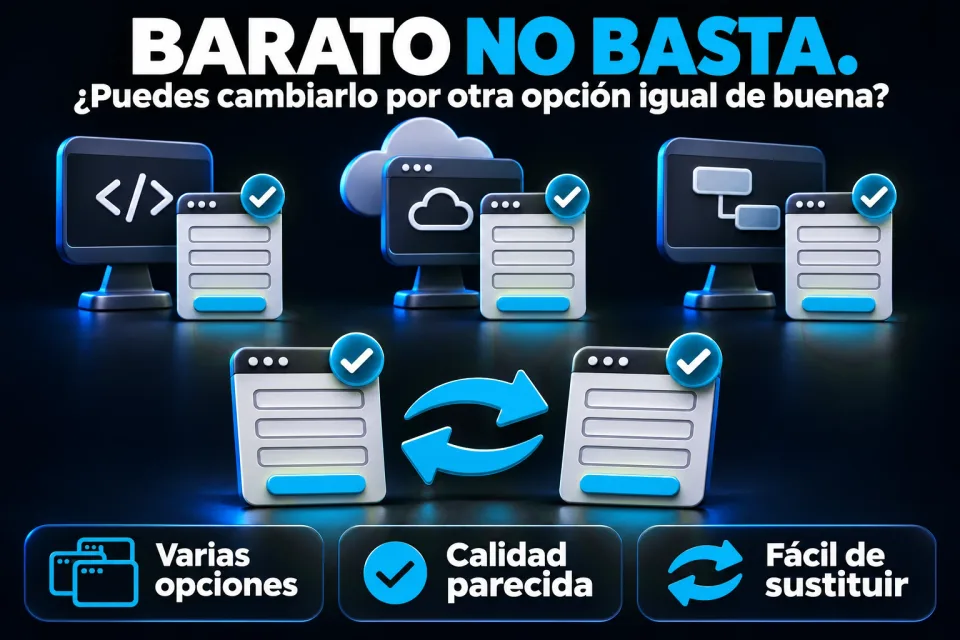
Think of a bag of ordinary sugar. If two brands offer the same quality, you'll probably buy whichever has the better price or is available right away.
That's the key feature of a commodity: you can switch suppliers without much change in what you get.
In software, imagine you need a contact form. If ten tools can create one that meets your needs, you have little reason to pay much more for one of them.
But being cheap isn't enough to make something a commodity. It also needs to be easy to replace and offer similar quality.
An app that costs less but loses your data or is easily hacked is hardly a substitute for one that doesn't.
I want to separate two things here: code is the set of instructions your computer executes.
Software as a whole also depends on other resources, such as data, connections to other services and management of the infrastructure it runs on.
Making code cheaper doesn't lower every cost equally.
What AI is changing
Even before AI, we had templates, frameworks, libraries and services to avoid writing the same things over and over.
AI expands that possibility. You can describe a screen, ask for a connection to another service or generate a first version of a product.
This mostly affects repetitive work that's easy to check: forms, simple screens or functions with clear rules.
If you used to pay for the hours and knowledge needed to write code, and now you can get a similar result with much less effort, the cost of producing it falls and supply grows.
And when something becomes easier to produce and competition increases, its price tends to fall.
That's the part of development I see moving toward a commodity. The question is how much of that saving carries through to a finished product that generates revenue or other benefits.
What we know so far
Three experiments at companies, involving 4,867 developers, estimated roughly 26% more completed tasks when developers were given access to a coding assistant. Results varied, and less experienced developers saw greater benefits. [1]
That supports the idea that AI can save work and improve productivity. It doesn't show that the software costs less to maintain or has the same quality over time.
Another study helps illustrate the limit. In their June 2026 write-up, the authors analyzed more than 100,000 developers. The use of different AI coding tools was associated with roughly 180% more code commits, but only 30% more releases. [2]
It was an observational study: those figures alone don't prove that AI caused the increase, and the study didn't measure whether the product actually performed better.
Writing more code doesn't translate into the same proportional increase in software that's ready to use. It still needs to be reviewed, tested, connected to existing systems and kept running.
These studies also don't show that prices have fallen across all development work or that any solution can replace another. There is evidence of savings in certain tasks; saying that all software is already a commodity goes beyond what we know.
What still has value
Imagine a booking app built with AI. It shows available times, saves a booking and sends a notification email. In an initial test, it works.
Then two people book the same time slot, and both receive confirmation. The screen looked good and worked, but the business rules hadn't been implemented or validated.

AI can help fix it. You still need to spot the problem, decide on the business rule and verify that the solution works.
Then comes another question: why would people trust this app over services that already solve the same problem?
Understanding the business and your customer, protecting data, providing support and earning users' trust are also essential parts of building a good software product.
Code becomes one component in the larger system.
At Sibila, I completed more than 30 installations of a customer communication product. I automated domain and server creation to save hours of setup.
Each installation still needed checking and support afterward. Saving work in one area didn't eliminate everything the customer needed.
How to apply this to your projects
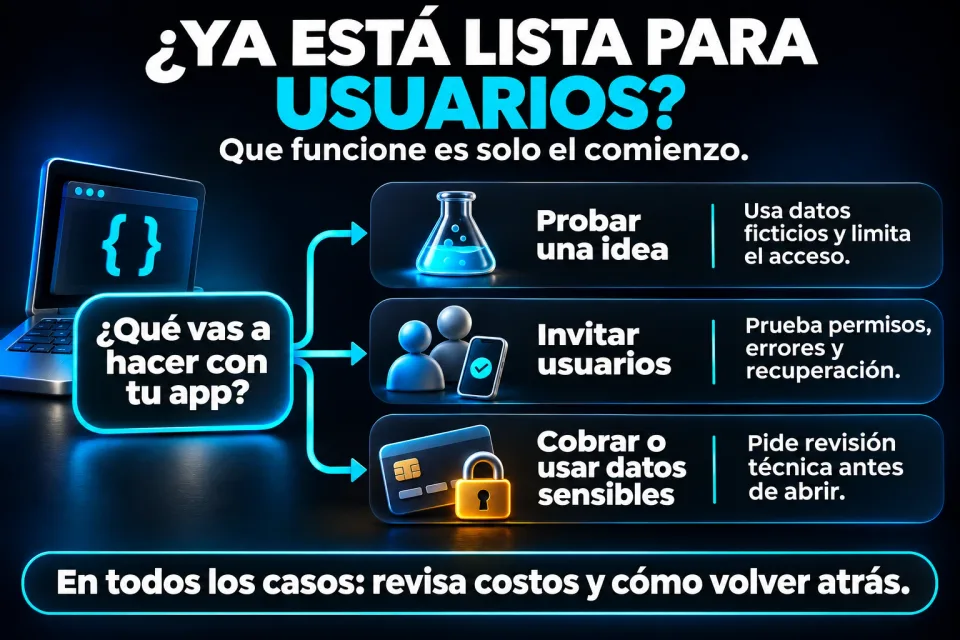
You can delegate code generation, but you're still responsible for what the code does. Before inviting users, check four things:
1. Understand what you're putting in their hands
Identify where data is stored, who can see it and what happens if something fails. Ask AI to explain the path a booking takes, and check it against the configuration. Resolve your questions before using real data.
2. Use some of the savings for testing
Define a rule: "Only one person can confirm each time slot." Test it from two accounts at the same time. Enter incorrect data and simulate an email failure.
If you already code, automate those tests with AI's help. Make sure they detect the intended failure, and run them again after every change.
3. Check security before publishing
From one account, try to open someone else's booking: the system should prevent it, even if you change the URL. Check for exposed keys and security advisories for the packages you use. AI and automated scans help, but their approval doesn't guarantee security.
4. Prepare for what comes next
Write down:
- Infrastructure and costs: where it runs, what you pay and your monthly budget.
- Failures: where you check errors and how you receive outage alerts.
- Recovery: how you restore a backup and roll back to a previous version. Test it.
You don't need complex infrastructure from the start. For payments or sensitive data, get a technical review before publishing.
How to use the time you get back
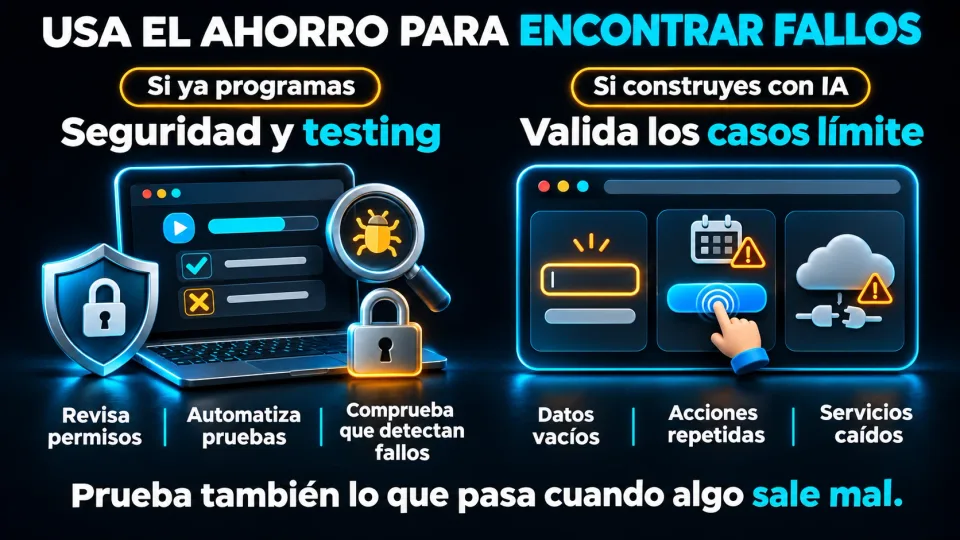
If you already code, spend more time on security and testing. Review permissions, exposed keys and dependencies with vulnerabilities. Automate tests for the important rules and run them with every change.
AI can help you write those tests, but make sure they catch errors: for example, they should fail if you allow the same time slot to be booked twice. Having everything show up green isn't enough.
If you build with AI without being comfortable with code, validate the edge cases: situations outside the path where everything goes right. Test what happens if:
- You leave a field empty or enter an invalid value.
- You press "Confirm" twice or repeat a request.
- The connection drops or a service stops responding.
Before testing, write down what should happen: "If I press twice, only one booking is saved." Use dummy data, check the saved result and ask AI for more cases that could break that rule. Verify its suggestions; if you can't assess the risk, get technical help.
Summary
AI is making code cheaper to produce. That brings it closer to a commodity when you can replace it with another option of similar quality.
But generating more code doesn't guarantee better software or prove that engineers are no longer needed.
Understanding the customer, checking the rules, protecting data and keeping the application running still have value.
- If you already code, invest the savings in security and automated tests that actually catch failures.
- If you build with AI without being comfortable with code, validate edge cases and check what happens with incorrect data, repeated actions or unavailable services.
You can delegate writing the code. You're still responsible for what you deliver.