
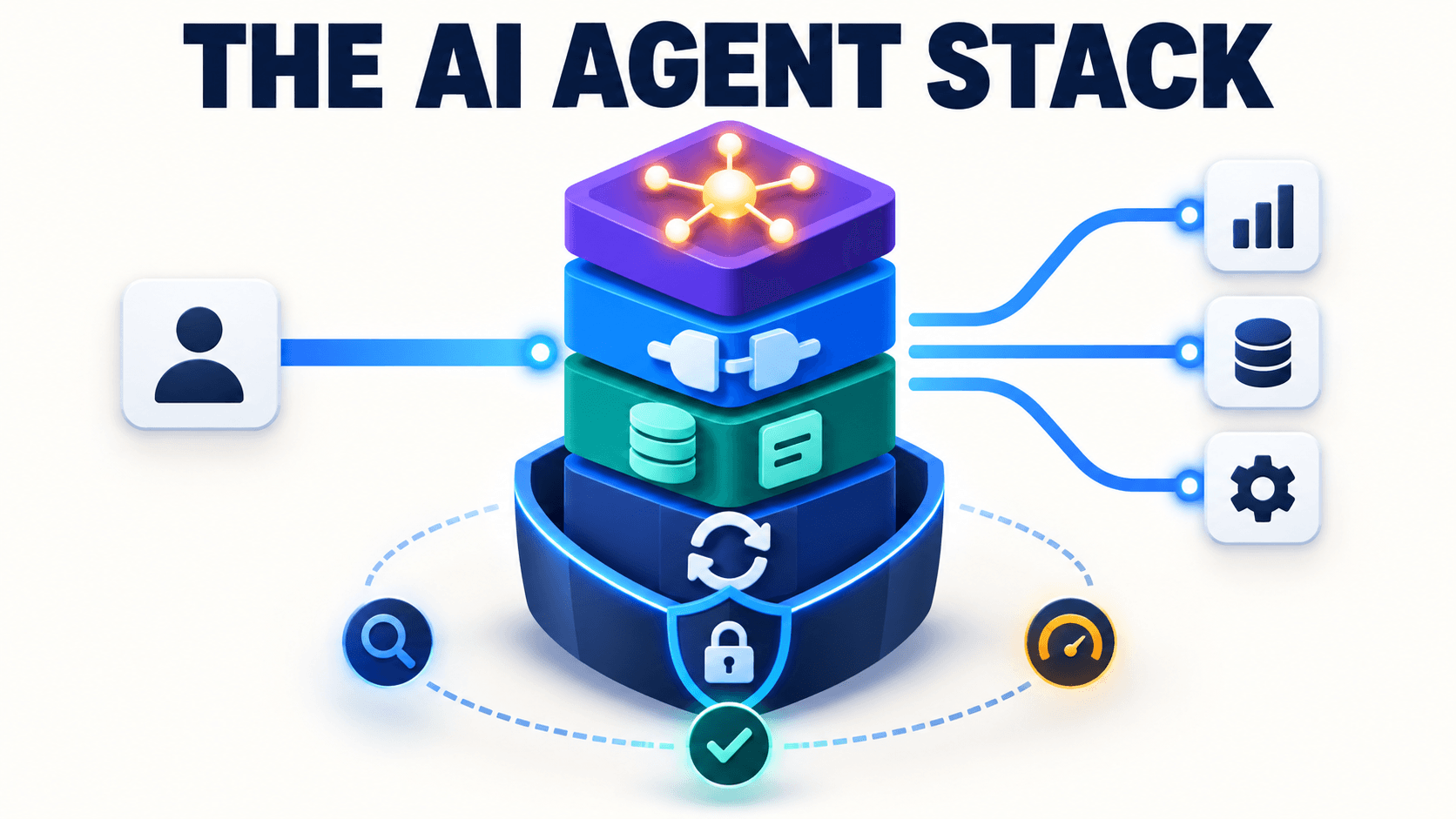
The demo worked: the agent read a ticket, looked up an order, and proposed a solution. Then someone asks, “Can we connect it to the real system?”
Taking it to production raises familiar questions: Which credentials does it use? What happens if it fails? How do we monitor it? It also raises a new one: Which decisions can the model make?
An AI Agent Platform brings together the services needed to answer those questions and operate the agent.
What is an AI agent?
- LLM (Large Language Model): a model trained to process and generate language. It receives an input and produces an output. On its own, it does not pursue a goal or execute actions in other systems.
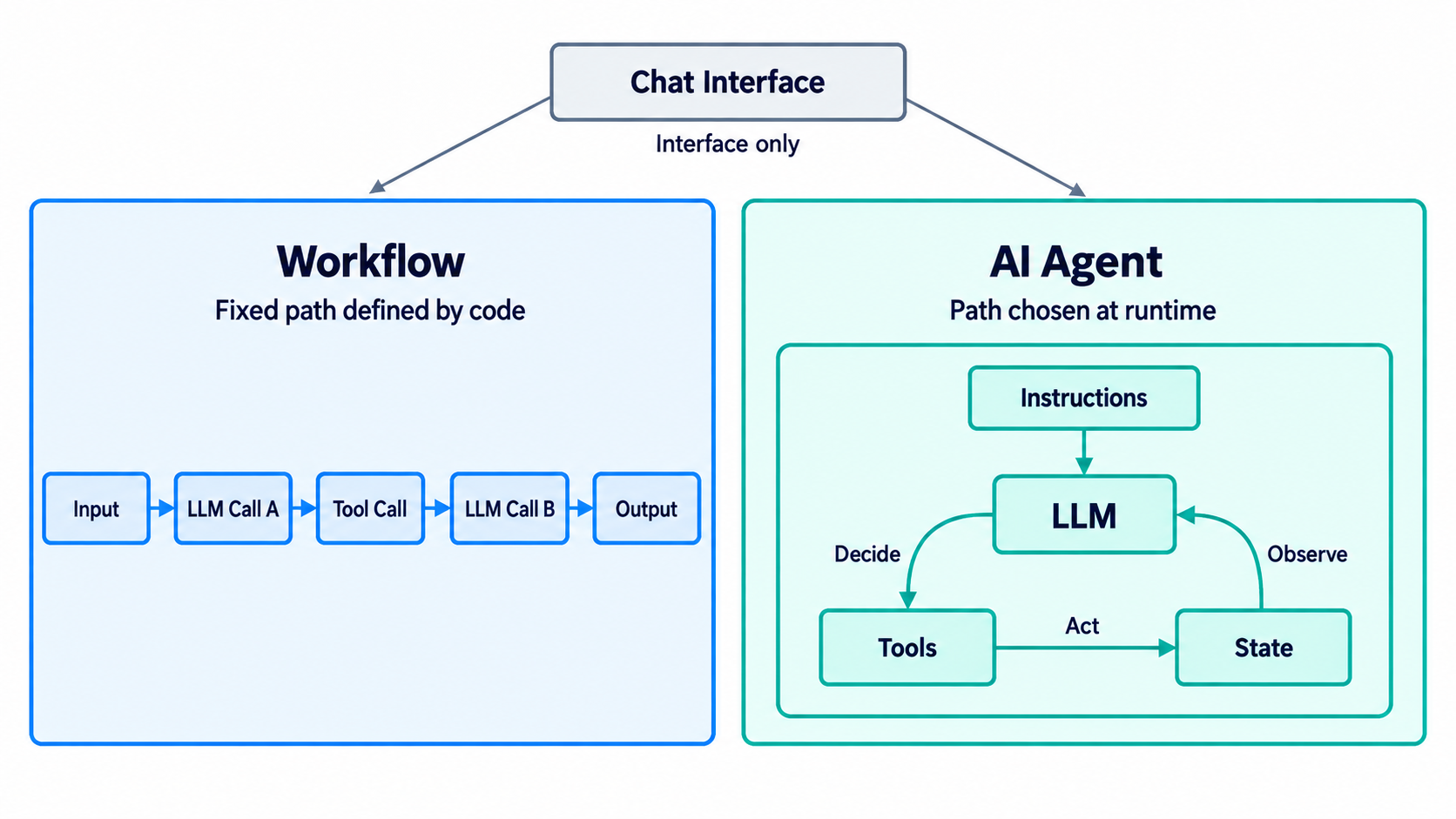
- AI agent: a system that uses a model, usually an LLM, to work toward a goal. It adds instructions, tools, state, and a loop: decide, act, review the result, and continue. [1]
- Workflow: a process whose steps and order are defined in code. In an agent, the model chooses part of the path while the system is running. Both approaches can be combined. [1]
- Chatbot: an interface for having a conversation with a system. Behind it, there may be simple responses, workflows, or agents.
The LLM is one part of the agent. It can propose looking up an order, but the surrounding software validates the request, runs the tool, and returns the result.
Given “investigate why this order failed,” the agent might check the order status, the payment, and failures reported by the provider. Its path changes according to what it finds. It stops when it reaches the goal, becomes blocked, or hits a limit.
If a process always validates three fields and updates one record, a workflow may be enough. An agent is useful when the steps change from case to case and that flexibility justifies the additional cost and response time. [1]
What is an AI Agent Platform?
AI Agent Platform: a set of services for building, deploying, connecting, supervising, and managing agents in production.
To understand what it provides, separate three pieces:
- Model — decides: interprets the context and proposes what to do next.
- Framework — coordinates: organizes the logic and execution of the steps.
- Platform — operates: provides permissions, limits, persistence, and monitoring.
As of September 2026, some current solutions cover these responsibilities:
- OpenAI Agents SDK is a framework with tools, agent handoffs, guardrails, sessions, and tracing. [7]
- Amazon Bedrock AgentCore provides runtime, memory, identity, tool access, policies, observability, and evaluations. It supports different models and frameworks. [2]
- Gemini Enterprise Agent Platform provides a managed runtime, sessions, memory, evaluation, observability, and isolated code execution. [8]
- Microsoft Foundry Agent Service lets you configure an agent with prompts or deploy your own code. In both cases, it manages execution, scaling, and identity. [9]
The practical difference is how much remains your team's responsibility: only the logic, or also execution, state, permissions, and monitoring.
The stack for building AI agents
The stack can be understood as five layers, ordered from decision-making to operational control:
- Model and orchestration. Decides what to do and coordinates the steps. You can use models from OpenAI, Anthropic, or Google together with OpenAI Agents SDK, LangGraph, or Google ADK. [1] [7] [8]
- Tools and integration. Connects the agent to specific actions, such as looking up an order or tracking a shipment. You can use REST APIs, MCP servers, AgentCore Gateway, or Microsoft Foundry Toolboxes. [2] [9]
- Context, knowledge, and memory. Keeps the task's progress, retrieved information, and data carried across sessions. You can use LangGraph, AgentCore Memory, or Google Sessions and Memory Bank. [2] [4] [8]
- Runtime and persistence. Runs and scales the agent, saves its progress, and lets it continue after an interruption. Options include AgentCore Runtime, Google Agent Runtime, and Microsoft Foundry Hosted Agents. [2] [8] [9]
- Identity and control. Limits who can use the agent, which data it can access, and which actions it can perform. You can use AgentCore Identity and Policy, Google IAM and Agent Gateway, or Microsoft Entra ID and RBAC. [2] [8] [9]
MCP (Model Context Protocol): an open standard for connecting AI applications to external data sources, tools, and workflows. Authorization remains the responsibility of your system; MCP does not define business permissions. [3] [5]
A vector database helps retrieve knowledge, but it does not confirm whether a transaction occurred.
A production example: resolving a ticket
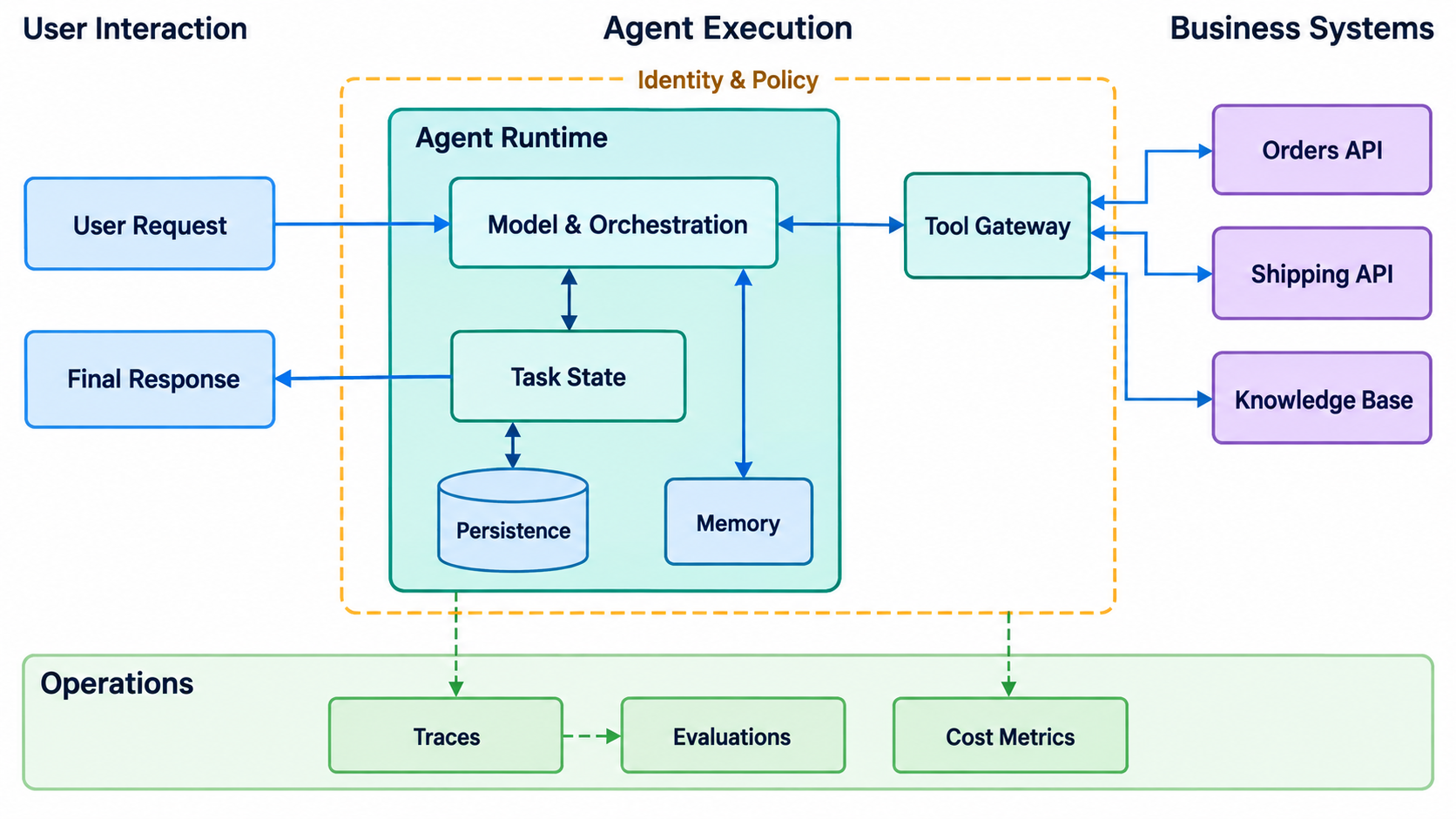
Imagine a support agent investigating why an order was delayed. Its stack could work like this:
- Model and orchestration: reads the ticket and decides whether it needs to check the order, shipment, or policy. It handles cases that require different steps.
- Tools and integration: connects the agent to the order and shipping APIs. It lets the agent act without giving it general access to those systems.
- Context, knowledge, and memory: keeps the order data, current progress, and relevant policy. It prevents information from being lost between steps.
- Runtime and persistence: runs the process and saves its progress. It can continue after a wait or interruption.
- Identity and control: limits the available data and actions. It prevents the agent from operating beyond the user's permissions or the business rules.
Together, these layers turn the model's decisions into a process connected to real systems with clear limits.
AI agent evaluation, observability, and costs
These three responsibilities reveal whether the agent works and how much it costs to operate:
- Evaluation — measures quality. The product team defines what it means to resolve the task. The platform runs test cases and scores the result and, when needed, the steps taken. This helps detect regressions when the model, instructions, or tools change. [6]
- Observability — explains each run. The platform stores a trace containing model calls, tools, their results, and the agent version. The team defines privacy, retention, and alerts. This makes it possible to reconstruct failures that do not appear in the final answer.
- Cost control — measures the whole process. The platform adds up the cost of the model, tools, runtime, and human review. The team sets limits and measures cost per completed task. A cheaper model can cost more overall if it requires additional steps or manual work.
For the support agent, we would test nonexistent orders, conflicting data, and provider outages. We would review both the final response and the actions performed.
Building or buying an agent platform
You do not have to build or buy the entire architecture. You can decide layer by layer.
- Product layer: includes instructions, orchestration, tools, business rules, and evaluation criteria. The team that understands the process usually builds it. It solves the specific use case.
- Platform layer: includes runtime, persistence, identity, secrets, traces, evaluations, and scaling. It can be internal or managed. It solves needs shared by multiple agents and teams.
The platform does not decide business permissions, expected quality, or allowed actions. Those responsibilities remain with your team.
The decision lies at that boundary. If several teams need the same execution, identity, and observability capabilities, centralizing them avoids duplicated infrastructure. If the selected platform does not provide the required isolation, controls, or recovery, you will need to complete that part.
Summary
- The architecture separates responsibilities: the model and orchestration choose the steps, tools act, context preserves information, the runtime executes, and identity limits access.
- The platform operates those pieces: it provides persistence, security, observability, evaluation, and cost control.
- The team keeps the business decisions: it defines permissions, allowed actions, and what it means to complete the task.
To get started, choose a narrow process and assign an owner to each layer. Then identify which components already exist, which ones a platform provides, and which ones you need to build.
References
- Anthropic — Building effective agents
- AWS — Amazon Bedrock AgentCore FAQs
- Model Context Protocol — What is MCP?
- LangChain — Persistence in LangGraph
- Model Context Protocol — Security best practices (draft documentation)
- Anthropic — Demystifying evals for AI agents
- OpenAI — Agents SDK
- Google Cloud — Gemini Enterprise Agent Platform
- Microsoft — Foundry Agent Service